
Thread life cycle
The number of threads within a process can vary widely, with threads being created and destroyed dynamically.
Thread creation (pthread_create()) involves allocating and initializing the necessary resources within the process's address space (e.g., thread stack) and starting the execution of the thread at some function in the address space.
Thread termination
(pthread_exit(),
pthread_cancel())
involves stopping the thread
and reclaiming the thread's resources. As a thread executes,
its state can generally be described as either
ready
or blocked.
More
specifically, it can be one of the following:
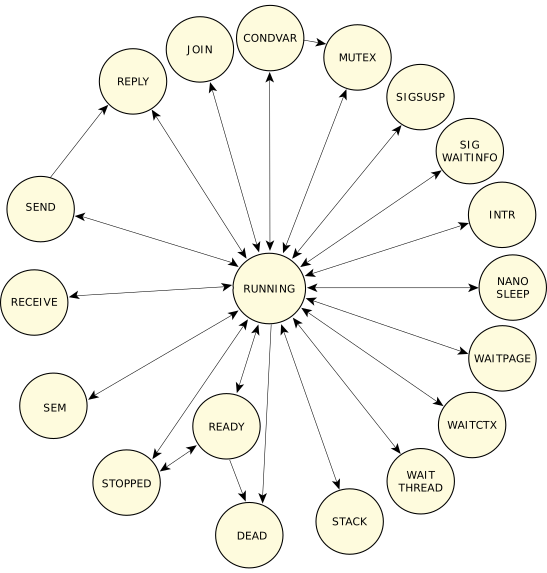
- STATE_CONDVAR
- The thread is blocked on a condition variable (e.g., it called pthread_cond_wait()).
- STATE_DEAD
- The thread has terminated and is waiting for a join by another thread.
- STATE_INTR
- The thread is blocked waiting for an interrupt (i.e., it called InterruptWait()).
- STATE_JOIN
- The thread is blocked waiting to join another thread (e.g., it called pthread_join()).
- STATE_MUTEX
- The thread is blocked on a mutual exclusion lock (e.g., it called pthread_mutex_lock()).
- STATE_NANOSLEEP
- The thread is sleeping for a short time interval (e.g., it called nanosleep()).
- STATE_NET_REPLY
- The thread is waiting for a reply to be delivered across the network (i.e., it called MsgReply*()).
- STATE_NET_SEND
- The thread is waiting for a pulse or signal to be delivered across the network (i.e., it called MsgSendPulse(), MsgDeliverEvent(), or SignalKill()).
- STATE_READY
- The thread is waiting to be executed while the processor executes another thread of equal or higher priority.
- STATE_RECEIVE
- The thread is blocked on a message receive (e.g., it called MsgReceive()).
- STATE_REPLY
- The thread is blocked on a message reply (i.e., it called MsgSend(), and the server received the message).
- STATE_RUNNING
- The thread is being executed by a processor. The kernel uses an array (with one entry per processor in the system) to keep track of the running threads.
- STATE_SEM
- The thread is waiting for a semaphore to be posted (i.e., it called SyncSemWait()).
- STATE_SEND
- The thread is blocked on a message send (e.g., it called MsgSend(), but the server hasn't yet received the message).
- STATE_SIGSUSPEND
- The thread is blocked waiting for a signal (i.e., it called sigsuspend()).
- STATE_SIGWAITINFO
- The thread is blocked waiting for a signal (i.e., it called sigwaitinfo()).
- STATE_STACK
- The thread is waiting for the virtual address space to be allocated for the thread's stack (parent will have called ThreadCreate()).
- STATE_STOPPED
- The thread has stopped, for example because it received a SIGSTOP or ThreadCtl() command.
- STATE_WAITPAGE
- The thread is waiting for physical memory to be allocated for a virtual address.
- STATE_WAITTHREAD
- The thread is waiting for a child thread to finish creating itself (i.e., it called ThreadCreate()).
In discussion and in the documentation, we usually omit the STATE_
prefix.
Page updated: